
Criminal Court Records in Pottawatomie County
A criminal court record begins the moment a charge is filed. The County Court Clerk opens a numbered case and keeps every paper after that. This file is the official record of the prosecution. It is separate from the arrest report the sheriff or police write, and separate from the jail booking sheet. The clerk's file shows what the court did with the case.
The District Court hears all state criminal cases in the county. Felonies carry a CF case prefix. Misdemeanors carry a CM prefix. A felony is the more serious class, and it can lead to prison time. A misdemeanor is the lesser class, often punished by a fine, probation, or county jail. City offenses are different again. Minor city crimes and ordinance violations start in municipal courts in Shawnee, Tecumseh, Maud, and McLoud, and those files are not part of the District Court record. For a wider look at every case type the clerk holds, see the county court records overview.
How to Search Pottawatomie County Criminal Court Records
Two free state portals carry District Court case files. The Oklahoma State Courts Network, known as OSCN, is the broadest. On Demand Court Records, known as ODCR, is the portal the County Court Clerk links from its own page. Both let you search by defendant name or by case number. A criminal case number looks like CF-2014-1 or CM-2022-100, with the prefix, the year, and a sequence number.
- Open the OSCN docket search, or open ODCR if OSCN shows a verification screen.
- Search by the defendant's last name and first name, or paste a full case number.
- Pick Pottawatomie County District Court and narrow by case type or filing date.
- Open the case to read the docket, the charges, and the disposition.
- Ask the County Court Clerk for a certified copy when you need the official version.
Public portals are a convenience, not the official file. Oklahoma Court of Criminal Appeals Rule 2.6 treats OSCN case search as a public access tool while the court's own case-management record controls. When a portal and the courthouse disagree, the courthouse wins. For sentenced state prisoners, the Oklahoma Department of Corrections runs a separate offender lookup. Review the corrections tools on the Oklahoma Department of Corrections page.
The corrections lookup covers people serving a state sentence, not everyone charged in the county. It even warns that its data is abbreviated and not an exact account of the sentence. So the District Court file stays the better source for what actually happened in a case.
Stages of a Pottawatomie County Criminal Case
A criminal case moves through set steps, and each step leaves a mark in the record. Charges come first. Then the defendant answers them in court. Motions and hearings follow. The case ends in a plea or a trial, and a sentence closes it. Reading the docket in order shows where a case stands today.
Case flow: Charges Filed › Arraignment › Pretrial / Motions › Plea or Trial › Disposition › Sentencing
| Stage | What Happens |
|---|---|
| Arraignment | The defendant is told the charges and enters a plea of guilty, not guilty, or no contest. Bond and counsel may be set here. |
| Pretrial / Motions | Lawyers file motions, exchange evidence, and argue legal questions. Felonies may add a preliminary hearing and a bind-over order. |
| Plea or Trial | Most cases end in a plea agreement. Others go to a judge or jury, who decide guilt count by count. |
| Sentencing | The judge sets the penalty, which may include prison, jail, probation, fines, and court costs. |
Felony files often carry more events than misdemeanor files. A docket may list a warrant issued, an initial appearance, a preliminary hearing, an appearance bond, a plea of guilty summary of facts, and a payment plan agreement. The County Court Clerk records each one as the case proceeds.
What a Pottawatomie County Criminal Court Record Shows
A case file is a stack of fields, not a single page. Some fields name the people. Others track money, hearings, and the outcome. The table below covers the parts readers ask about most. Many cases also list a financial ledger with clerk fees, victim assessments, and other state funds.
| Field | What It Shows |
|---|---|
| Case Number | The unique identifier, such as CF-2022-337, with the prefix, year, and sequence. |
| Caption / Defendant | The case style, written as State of Oklahoma versus the named defendant. |
| Charges | Each offense or cause, the statute behind it, and the count number. |
| Docket Events | Dated entries for filings, hearings, warrants, orders, and continuances. |
| Plea | The answer entered, commonly guilty, not guilty, or no contest. |
| Disposition | The result for each charge, such as guilty plea, dismissed, or acquitted. |
| Sentence | The penalty, including any prison, jail, probation, fines, and costs. |
Documents may be attached as PDF or TIFF images, though some are held at the clerk's counter only. Sensitive identifiers stay masked. Social Security numbers, financial account numbers, and minor data are redacted from the public view.
Charges vs. Convictions
Being charged is not the same as being convicted. A charge is an accusation. A conviction is a finding of guilt by plea or verdict. A criminal court record can show charges that were dropped, dismissed, or that ended in acquittal. The record stays public either way, so a careful reader checks the disposition before assuming an outcome. The charges themselves are explored further on the county arrest records and court charges page.
| Charge | Conviction | |
|---|---|---|
| Stage | Accusation | Verdict or plea |
| Burden of Proof | Probable cause | Beyond reasonable doubt |
| Public Record | Yes | Yes |
| Means Guilt | No | Yes |
Reading Dispositions and Sentences
The disposition line tells you how a charge ended. Common entries are guilty, not guilty, dismissed, and no contest, also written as nolo contendere. Oklahoma adds two sentencing terms that confuse many readers. A deferred sentence and a suspended sentence are not the same thing, and the difference matters.
- Deferred sentence
- The judge delays judgment and sets conditions. If the defendant completes them, the case can end without a formal conviction entered.
- Suspended sentence
- The judge imposes a sentence but suspends the time served, subject to compliance. A conviction is entered, even though the defendant stays out of custody.
- Probation
- Supervised release with rules. Breaking the rules can trigger a revocation proceeding.
- Revocation
- A later filing that asks the court to enforce the original sentence after an alleged violation.
A sentence often pairs custody with money. The ledger may list fines, court costs, and assessments for victim services, the district court revolving fund, and other state funds. Reading the sentence and the ledger together gives the fuller picture.
Note: A deferred sentence can keep a formal conviction off the record, while a suspended sentence still records the conviction even when no jail time is served.
Sealed vs. Expunged Pottawatomie County Criminal Records
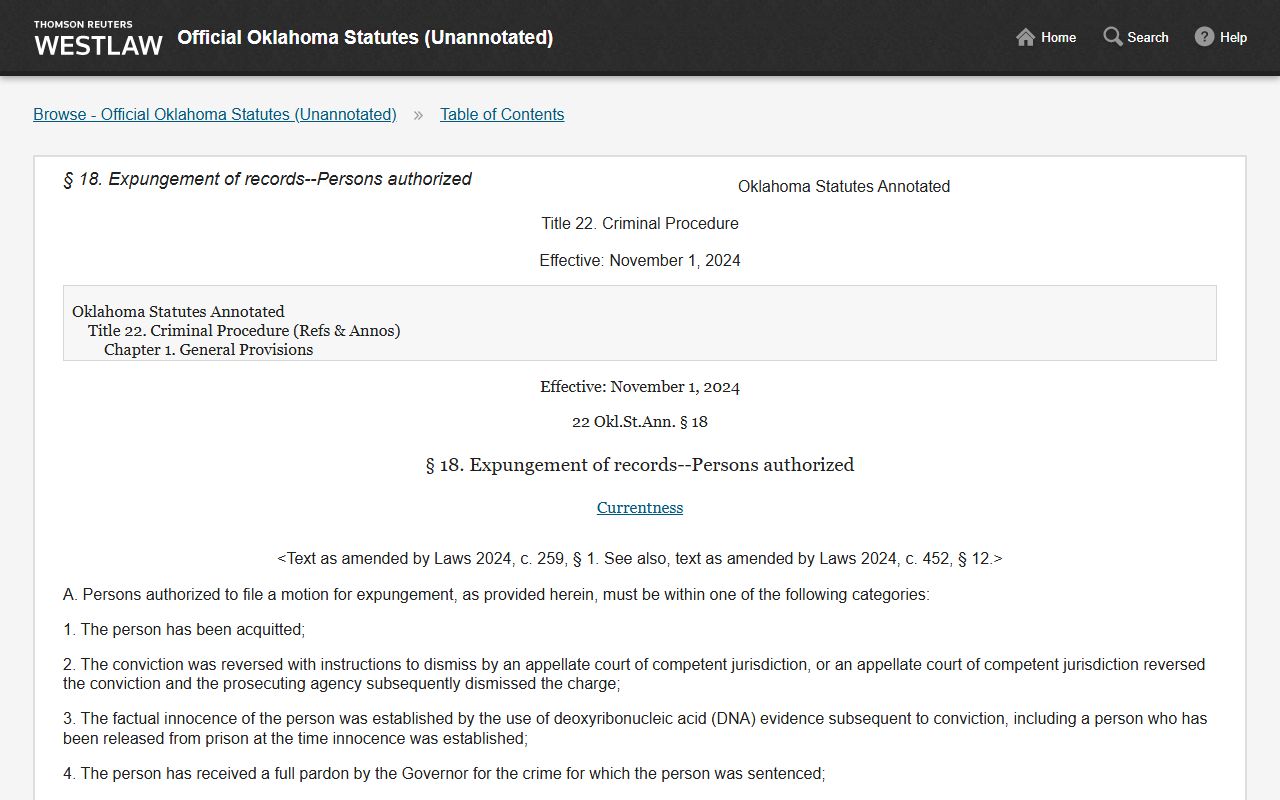
Some criminal records leave the public view. Sealing and expungement both limit access, but they work differently. A sealed file is hidden from public search yet still exists. An expunged record is treated under the statute as though it never happened. Oklahoma sets eligibility for expungement in 22 O.S. Section 18, which lists the categories of people who may ask a District Court to clear a record.
| Sealed | Expunged | |
|---|---|---|
| Visibility | Hidden from public | Treated as never existed |
| Law Enforcement | Limited access | Very limited |
| Eligibility | Set by court order in the District Court | Categories listed in 22 O.S. Section 18 |
The state criminal records office does not pre-screen who qualifies. Read the eligibility framework on the OSBI criminal history expungement page.
OSBI states plainly that it cannot pre-approve eligibility and points filers to the statute itself. A person reviews whether their arrest, dismissal, or sentence fits a listed category, then files a petition in the District Court where the case arose. The statute text appears on the official Oklahoma legal materials site. Open it through the Oklahoma Section 22-18 expungement statute.
A granted order does not erase a file on its own. The judge signs the order, and it must be entered and sent to each record holder. Dismissal alone does not clear a case automatically, so the paperwork still has to be done.
Public Access to Pottawatomie County Criminal Court Records
Criminal case files are open to the public by default in Oklahoma. The Open Records Act sets the framework, and the court rules build on it. Most people start online, then turn to the County Court Clerk for certified copies and older files. Access during business hours is the rule, so local office hours matter when you need the counter.
Key Statutes:
51 O.S. Section 24A.1 - Names and frames the Oklahoma Open Records Act, the base law for public access.
51 O.S. Section 24A.5 - Public-body records are open for inspection and copying unless a law makes them confidential.
OCCA Rule 2.6 - OSCN case search is a public convenience, while the court's case-management record controls.
The District Attorney and Public Defense
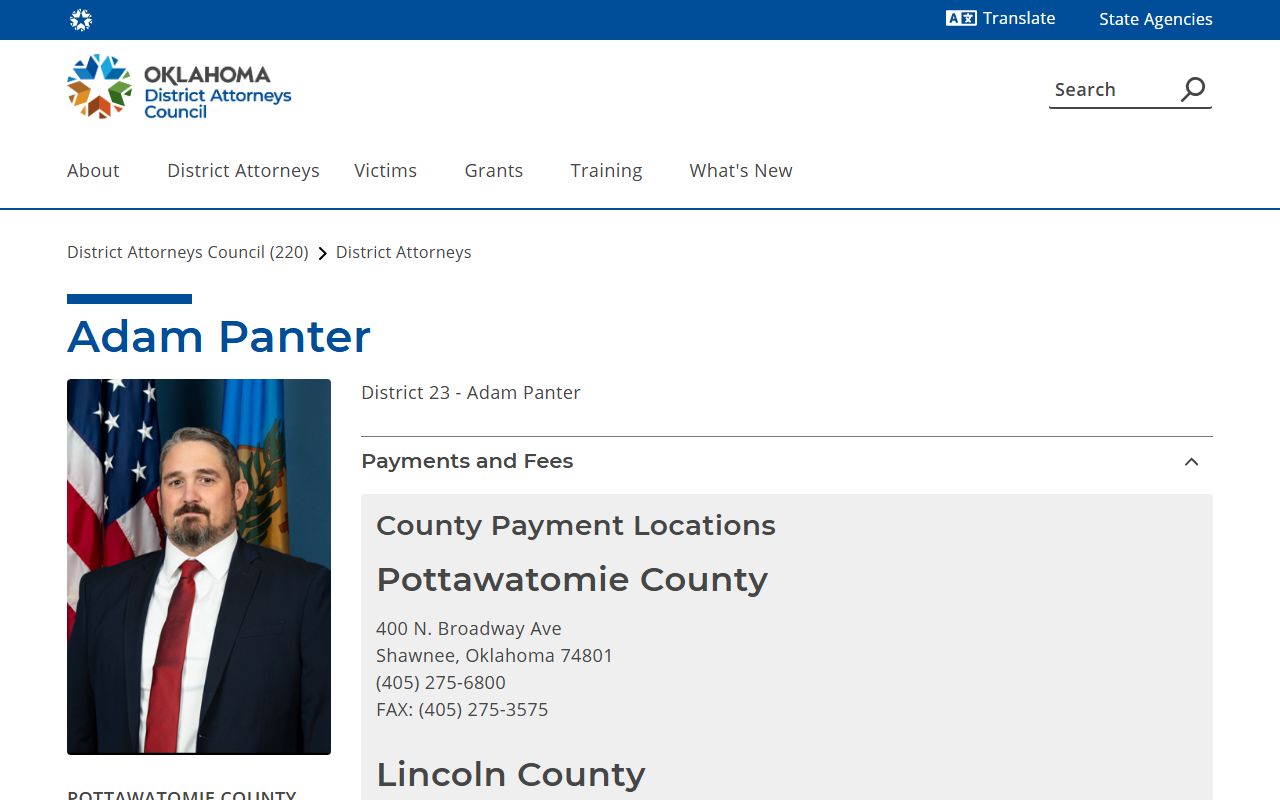
Criminal charges in the county are filed and prosecuted by the District Attorney for District 23, which covers Pottawatomie and Lincoln Counties. The current District Attorney is Adam Panter, and his office appears in every case caption as the State of Oklahoma. The Pottawatomie office sits in downtown Shawnee near the courthouse. The DA decides which charges to file and carries the case through hearings and trial.
See the prosecutor's office details on the Oklahoma District Attorneys Council District 23 page.
Defendants who cannot afford a lawyer may qualify for appointed counsel. In Pottawatomie County, that defense comes through the Oklahoma Indigent Defense System, which serves the county from its Norman office. The system handles non-capital trial defense for eligible clients when the court appoints counsel.
Check the county coverage on the OIDS Pottawatomie County coverage page.
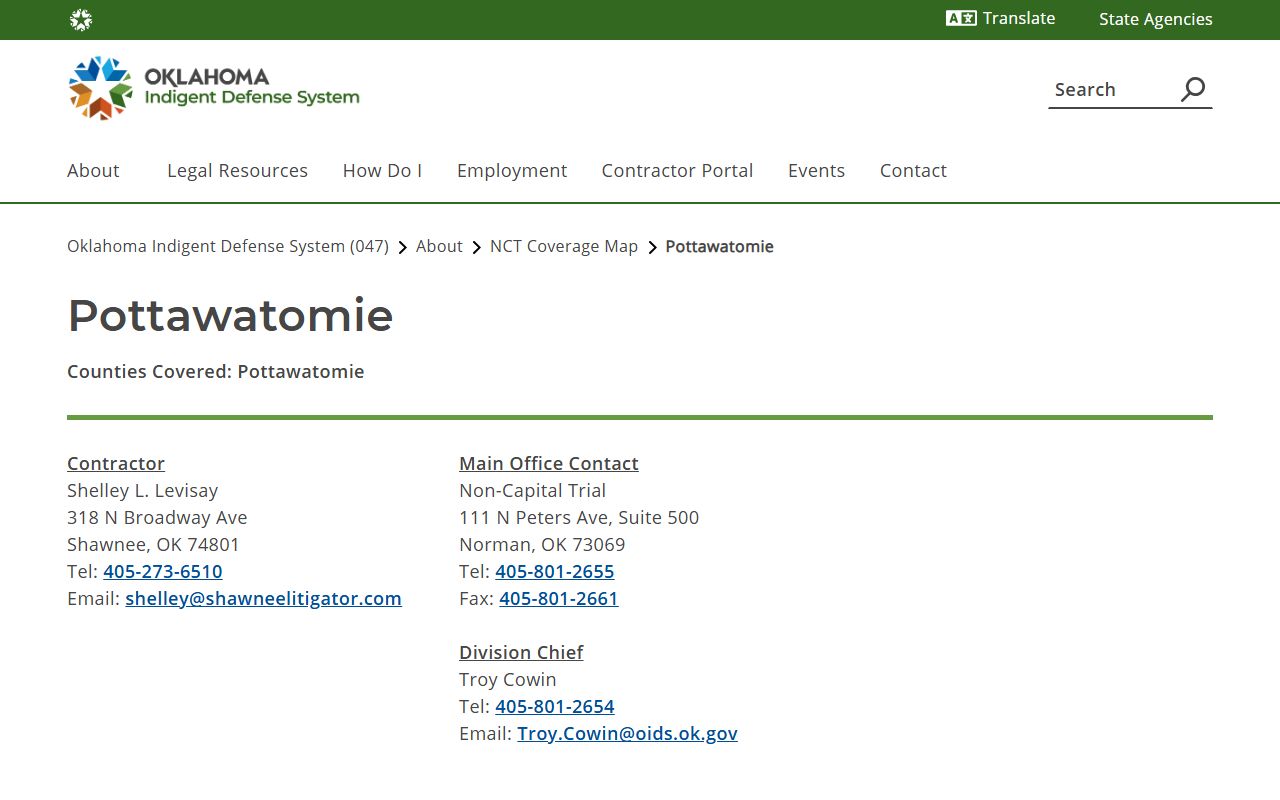
The Norman office handles intake and contact for the county. Eligibility is decided by the court based on the defendant's means. The page above lists the OIDS contact line at 405-801-2601 for questions about appointed defense.
Background Check Considerations
A casual case lookup is not the same as a formal background check. Reading a docket online tells you what one file shows. A regulated background check for hiring, housing, or credit follows federal rules and uses approved sources. Treat a single criminal court record as one piece, not a complete history. Charges, dispositions, and sealing status can all change a person's true picture.
Important: This site is not a consumer reporting agency under the Fair Credit Reporting Act, and its records may not be used to decide credit, employment, housing, or insurance.
Restricted Criminal Court Records in Pottawatomie County
Not every criminal matter is open. Some files are closed by law, and others are masked in part. Juvenile cases sit outside the normal public docket and usually do not appear like adult cases. Sealed and expunged records drop out of public search once a court orders it. Adoption and mental health proceedings are tightly held because of privacy interests.
Even on open cases, the court withholds certain details. Personal identifiers, protected addresses, and minor names are redacted. Some warrant and investigation material may not show until it is executed or unsealed. When a record does not appear online, the County Court Clerk can confirm whether it exists, is sealed, or is simply held at the counter.